For many students, academic integrity only becomes real when something goes wrong. An email from the university. A sudden meeting request. A sentence in an assignment flagged by software you didn’t even know existed. What makes it worse is that most students caught in these situations never meant to cheat.
In Australia, academic integrity rules are strict, detailed, and enforced consistently. Sharing notes, copying structure from samples, or getting help from seniors may have been normal elsewhere. Here, the same actions can damage your grades, record, and confidence.
This article breaks down academic integrity rules in Australia in a way that reflects how students actually struggle with assignments, pressure, language barriers, and fear of failure while showing you how to protect your assignment integrity without isolating yourself or giving up support.
What Academic Integrity Really Means in Australian Universities?
Academic integrity in Australia is not just about avoiding cheating. It’s about whether your submitted work genuinely reflects your own learning.
Universities expect students to demonstrate:
- Honesty in how work is produced
- Transparency in using sources and support
- Responsibility for understanding rules
- Fairness to other students
This applies to everything: essays, reports, presentations, online quizzes, group work, and even draft submissions.
A simple way to understand it is this:
If your lecturer asked you to explain your assignment step by step, would you confidently be able to do it?
The Core Academic Integrity Rules Students Must Follow
Although policies differ slightly across universities, these rules are consistent across Australia.
Originality Is Mandatory, Not Optional
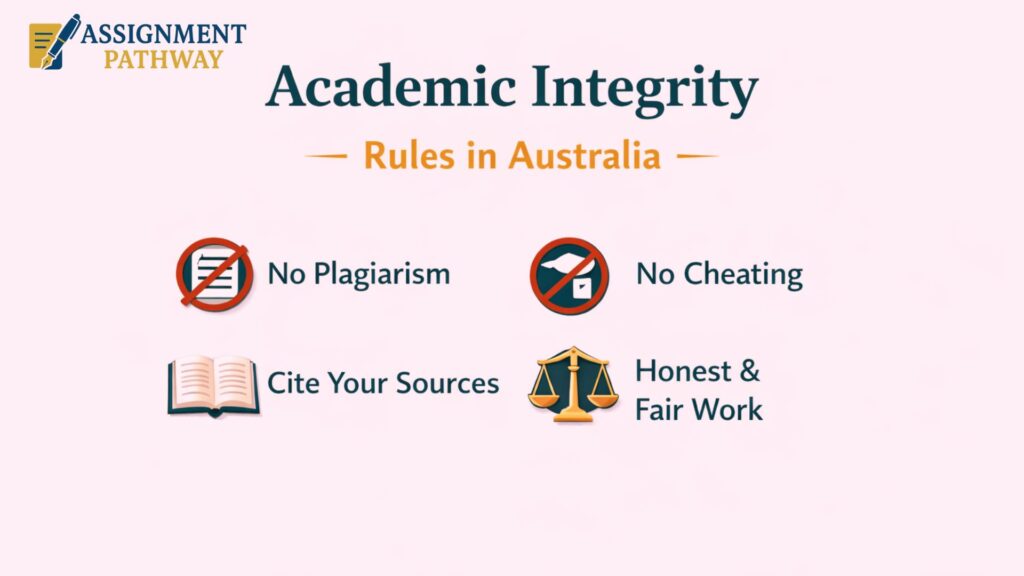
Your assignment must be written by you and based on your understanding. Even if content is freely available online, submitting it as your own work breaches assignment integrity. Reusing old assignments, copying classmates, or purchasing work partially or fully counts as misconduct.
Referencing Is About Credit, Not Formality
Many students think referencing is just a technical requirement. In Australia, it’s about intellectual honesty. If an idea, statistic, or structure came from somewhere else, it must be acknowledged properly. Poor paraphrasing or missing citations can still be considered plagiarism, even without bad intentions.
Help Is Allowed but Only in Specific Forms
This is where most confusion happens. Allowed support usually includes- editing for grammar and clarity, feedback on structure or argument flow, study guidance and concept explanation.
Not allowed includes- someone writing parts of your assignment, submitting AI-generated text as your own, heavy rewriting that changes meaning or voice.
If help replaces your thinking, it violates assignment integrity.
What Happens If You Break Academic Integrity Rules in Australia?
Consequences depend on severity and whether it is a first offence or it keep on repeating, but outcomes can includes:
- Reduced marks or zero marks
- Failing the particular subjects
- Format misconduct records
- Suspension or exclusion
- Serious cases affecting student visa status
Investigations are formal, documented, and stressful. Prevention is always easier than appeals.
A Practical Framework to Protect Your Assignment Integrity
Before submission, pause and run through this checklist:
- Did I write this assignment myself, from understanding to final draft?
- Are all sources clearly referenced?
- Is the language consistent with my usual writing style?
- Could I explain every part of this assignment if questioned?
- Was any support used for learning, not substitution?
If you hesitate on any point, revise before submitting.
Getting Academic Support Without Breaking the Rules
Academic integrity does not mean struggling alone.
Safe support focuses on:
- Understanding assignment questions
- Learning how to actually structure the arguments
- Improving academic writing and speaking skills
- Correcting grammar and formatting
- Receiving feedback but not replacing of ideas
When support helps you learn how to do the work, it aligns with integrity standards.
Why Most Articles on This Topic Don’t Actually Help?
Many blogs either threaten students with penalties or oversimplify integrity into don’t cheat. They ignore the grey areas where real students make mistakes especially international students navigating a new academic culture. Academic integrity in Australia is not about perfection. It’s about intention, learning, and responsibility.
The Real Takeaway: Integrity Is Protection, Not Restriction
Academic integrity rules in Australia exist to protect your degree, your reputation, and your future opportunities. Once you understand them, they stop feeling like obstacles and start feeling like a framework you can work within confidently. If you’re ever unsure, ask questions early, document your work process, and prioritise learning over shortcuts. That mindset alone keeps most students safe.
Assignment integrity isn’t about fear. It’s about control over your work, your grades, and your future.
Frequently Asked Questions
1. What is assignment integrity?
It means the work you submit must reflect your own understanding and effort, with proper referencing.
2. Is accidental plagiarism still a problem?
Yes, even unintentional mistakes can lead to penalties, though first-time cases are usually treated more lightly.
3. Are AI tools allowed?
It totally depends on your university and subjects or your professors. Using AI generated content as your own without permission usually violates integrity rules.