
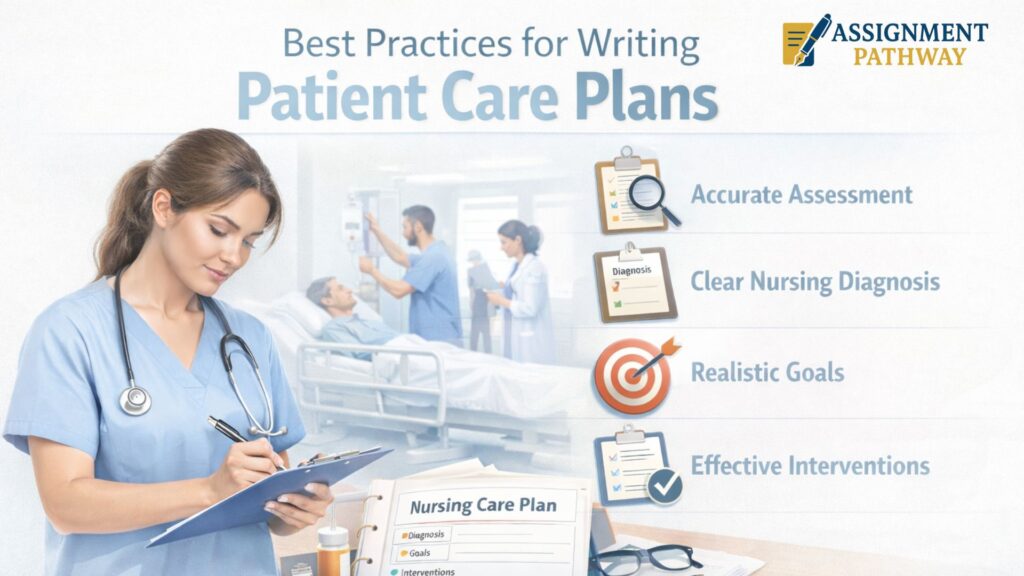
For many nursing students, writing a nursing care plan feels overwhelming. It’s not just another assignment, it’s a structured clinical document that reflects how you think, prioritize, and deliver patient-centered care. In real hospital settings, care plans influence handovers, guide interventions, and shape patient outcomes. When written poorly, they create confusion. When written well, they prevent errors. If you’re a university nursing student searching for clarity, this guide will walk you through how nursing care plans actually work in practice, not just how they’re described in textbooks.
Understanding What a Nursing Care Plan Is Really For
A nursing care plan isn’t about filling boxes with textbook language. Its purpose is to:
- Translate assessment findings into actionable steps
- Organize clinical judgment
- Communicate priorities clearly to the healthcare team
- Reduce risks and improve continuity of care
In real practice, a care plan becomes most valuable during shift changes. If your documentation is vague “Monitor patient closely”, the next nurse is left guessing. Specific, measurable, and clinically grounded documentation is what makes a difference.
Step 1: Start With Focused, Accurate Assessment
Everything in a nursing care flows from assessment. Weak assessment equals a weak plan.
What Students Often Get Wrong
Many students list every abnormal finding without identifying what truly matters. For example:
- Slightly elevated temperature
- Mild anxiety
- Complaints of fatigue
- Surgical incision pain
Instead of prioritizing, they attempt to address everything equally. In practice, this creates unsafe care.
What to Do Instead?
Ask yourself:
- What is the immediate risk?
- What could deteriorate quickly?
- What is causing the most functional limitation?
If a post-operative patient reports 8/10 pain and refuses to mobilize, the priority might be Acute Pain, not mild fatigue.
Strong assessment includes:
- Objective data (vitals, lab results, wound status)
- Subjective data (patient-reported symptoms)
- Context medical history, medications, social factors
Document details clearly. Patients in pain are weak.
“Patient reports sharp incisional pain rated 8/10, worsens with movement, guarding abdomen” is clinically useful.
Step 2: Formulate Clear and Accurate Nursing Diagnoses
A nursing diagnosis is not a medical diagnosis. This is where many nursing students lose marks.
When writing a nursing plan, use the PES format:
- Problem
- Etiology
- Signs and symptoms
Why Does This Matters?
If the etiology is wrong, your interventions will be ineffective.
If you write “Impaired mobility related to weakness” but the actual issue is pain, you’ll miss the root cause.
Be precise. Always connect the diagnosis directly to your assessment findings.
Step 3: Set Realistic, Measurable Goals
Goals should guide care, not sound impressive.
Weak Goal Example:
“The patient will improve.”
Improve how? By when?
Strong Goal Example:- “Patients will report pain ≤ 3/10 within 30 minutes of analgesic administration.”
Notice that it is:
- Specific
- Measurable
- Time-bound
- Directly linked to the diagnosis
Avoid writing goals that are unrealistic. A post-stroke patient will not regain full mobility in 24 hours. Writing unrealistic goals shows lack of clinical reasoning.
Step 4: Plan Interventions That Reflect Clinical Logic
Interventions are where your thinking becomes visible.
Many students list generic actions like:
- Monitor vital signs
- Encourage fluids
- Provide education
But why? For what purpose? Each intervention must connect to the diagnosis and goal.
Example: Acute Pain Nursing Care Plan
Interventions:
- Assess pain characteristics every 4 hours using standardized scale
- Administer prescribed analgesics
- Reposition patient for comfort
- Teach splinting techniques during coughing
Each intervention has a clear rationale:
- Monitoring tracks effectiveness
- Medication reduces physiological pain
- Positioning reduces mechanical strain
- Splinting prevents further discomfort
Without rationale, your plan looks memorized rather than clinically reasoned.
Step 5: Evaluation Is Not Optional
Evaluation is where many nursing care fall apart.
Students often write:
“Goal met.” That’s insufficient.
Evaluation should answer:
- Was the goal achieved?
- What evidence supports this?
- Should the plan continue, change, or stop?
Example:
“After analgesic administration, patients report pain 2/10 within 25 minutes. Goal achieved. Continue the current pain management plan.”
If pain remains 7/10, the plan needs revision, perhaps reassessment, medication review, or non-pharmacological additions.
Common Mistakes That Lower Grades and Affect Real Care
1. Copying from Templates Without Adjusting to the Patient
Templates are helpful, but real patients are complex. A diabetic patient with a wound and limited finances requires different interventions than one with strong family support. Personalization is critical.
2. Writing Vague Interventions
“Observe patient condition” is unclear.
What condition? How often? What are you looking for?
Vagueness leads to missed complications.
3. Ignoring Psychosocial Factors
Many nursing care plans focus only on physical symptoms. But anxiety, cultural background, health literacy, and family dynamics directly affect recovery.
For example, a patient refusing insulin may not be “non-compliant” they may fear injections or misunderstand instructions. Address the real barrier.
Handling Grey Areas in Nursing Care Plans
Clinical scenarios are rarely straightforward.
When Multiple Problems Compete
A patient may have:
- Risk for infection
- Impaired mobility
- Acute pain
- Anxiety
You cannot prioritize all equally.
Use frameworks like:
- ABC (Airway, Breathing, Circulation)
- Maslow’s hierarchy
- Risk of harm
Life-threatening issues always come first.
When Evidence Is Unclear
Sometimes assessment findings are incomplete. In such cases:
- Document what you know
- Plan further assessment
- Avoid assumptions
Never guess to make the care plan look complete.
A Practical Checklist Before Submitting Your Nursing Care Plan
Before turning in your assignment, review:
- Does every diagnosis link directly to assessment data?
- Are goals measurable and time-bound?
- Does every intervention have a clear rationale?
- Is prioritization justified?
- Have psychosocial factors been considered?
- Is evaluation specific and evidence-based?
If you cannot explain your reasoning verbally, your documentation likely needs revision.
How Nursing Care Plans Improve Clinical Confidence?
Writing a strong plan trains your clinical thinking. It forces you to:
- Analyze rather than memorize
- Prioritize under pressure
- Connect theory to real patients
- Anticipate complications
During placements, instructors can tell immediately which students truly understand patient care. The difference lies in structured thinking. When done correctly, a care plan becomes a safety tool not just an academic requirement.
Final Practical Advice
If you feel stuck while writing a plan, step away from the template and ask:
“If I were responsible for this patient for the next 8 hours, what would I be most concerned about?”
Start there. Focus on clarity over complexity. Be specific. Justify every decision. Think about real consequences, not just grading rubrics. Mastering plans doesn’t happen overnight, but each carefully written plan strengthens your clinical judgment. And in nursing, sound judgment is what protects patients the most.