If précis writing makes you uneasy, that’s completely normal. Most students don’t struggle because they’re bad at English, they struggle because they’re unsure what exactly is expected. Should you shorten aggressively? Keep the author’s words? Rewrite everything? One wrong move and it feels like marks will disappear. This guide is written with that uncertainty in mind. No textbook language, no exam-hall myths, just a practical explanation of how précis writing actually works and how to approach it with confidence.
What Précis Writing Is Really About And What It’s Not?
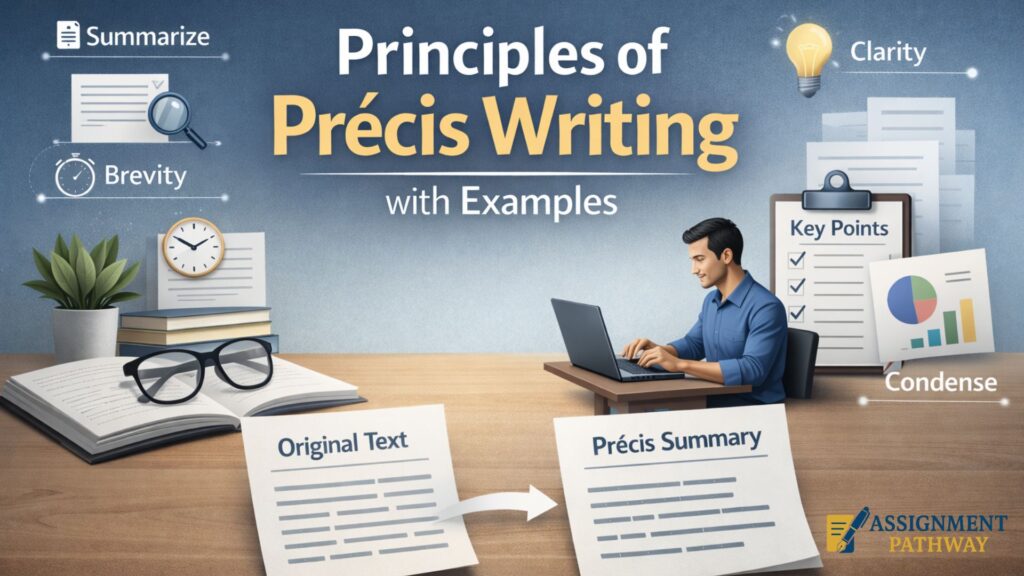
Précis writing isn’t about cutting sentences until the passage looks smaller. It’s about showing that you genuinely understood what the author was trying to say and can explain it clearly in fewer words.
When an examiner reads a précis, they’re silently checking three things:
Did you grasp the main idea?
Did you remove details without damaging the meaning?
Did you rewrite the ideas in your own neutral language?
A good précis feels like a clean explanation, not a rushed trimming exercise. If your version reads like you simply deleted lines, that’s where problems start.
First Principle: Understand the Core Idea Before You Write
The biggest mistake students make is starting to write before they’re clear about the passage itself.
Before you pick up your pen, pause and ask yourself:
If I had to explain this passage to a friend in one or two sentences, what would I say? That answer is the backbone of your précis.
In practice, this means reading the passage twice. The first time, just understand it. The second time, lightly mark the main claim and the sentences where the author shifts direction or draws a conclusion. If everything feels important, that’s a sign you haven’t located the central idea yet. Once the main argument is clear, writing becomes far less stressful.
Second Principle: Follow the Author’s Thinking, Not Their Sentences
Many students believe they must compress paragraph by paragraph or keep the same order of ideas. That’s not true.
What matters is the logic, not the layout. Sometimes an author explains the background first and reveals the real point later. In a précis, it’s perfectly fine to bring the main idea forward and mention the background briefly. You’re not changing the meaning you’re clarifying it. Think of it as retelling the argument in a cleaner way. If your précis reads smoother than the original, that’s usually a good sign.
Third Principle: Remove Details Without Panic
This is where hesitation kicks in. Students worry that removing examples or statistics will weaken the précis. Here’s a simple rule that works well in exams: If a detail explains how or how much but not what the main idea is, it can usually go.
You should keep the author’s key arguments, cause-and-effect links, and final viewpoint. You can safely drop long illustrations, repeated explanations, names, and decorative language unless they are absolutely central to the argument. A précis is not meant to showcase everything the author wrote. It’s meant to preserve meaning, not volume.
Fourth Principle: Keep the Tone Calm and Objective
Even if the original passage sounds emotional or critical, your précis should not. Students often copy strong words or add their own reactions without realising it. This turns the précis into a commentary, which examiners don’t want. Your job is to report the author’s ideas, not amplify them.
For example, instead of repeating dramatic language, gently neutralise it. The meaning stays the same, but the tone becomes academic and controlled.
Fifth Principle: Use Your Own Words Every Time
This part is non-negotiable. A précis that borrows phrases from the passage signals weak understanding, even if the writing looks polished. A good habit is to read the passage, close it, and mentally explain the argument as if you were teaching it to someone else. Then write from that explanation. If your sentences sound too similar to the original, pause and rephrase. The goal is clarity, not elegance.
A Simple Method You Can Rely On in Exams
When time is limited and nerves are high, structure helps. Use this approach:
Read the passage carefully
Identify the main idea
Note the supporting points
Remove examples and repetition
Rewrite the argument smoothly in your own words
Check that nothing essential is missing
You don’t need to over-edit. If it makes sense and feels complete, it’s likely good enough.
Mistakes That Commonly Cost Marks
Students often lose marks not because they misunderstand, but because they rush.
Staying too close to the original wording suggests shallow comprehension.
Over-shortening makes the précis vague.
Adding personal opinions breaks objectivity.
Giving equal space to minor and major ideas distorts the argument.
How Short Is “Short Enough”?
There’s no fixed length that guarantees success. A strong précis feels compact but complete. If the meaning is intact and the flow is clear, you’ve done your job. Examiners value sense far more than aggressive cutting.
A Final Word for Reassurance
Précis writing is not a talent you’re born with. It’s a skill that improves every time you practise thoughtfully. If your first few attempts feel awkward, that doesn’t mean you’re bad at it means you’re learning how to think more precisely. Once understanding comes first, the writing naturally follows. With the right mindset, précis writing stops feeling like a risk and starts becoming one of the safest scoring areas in exams.