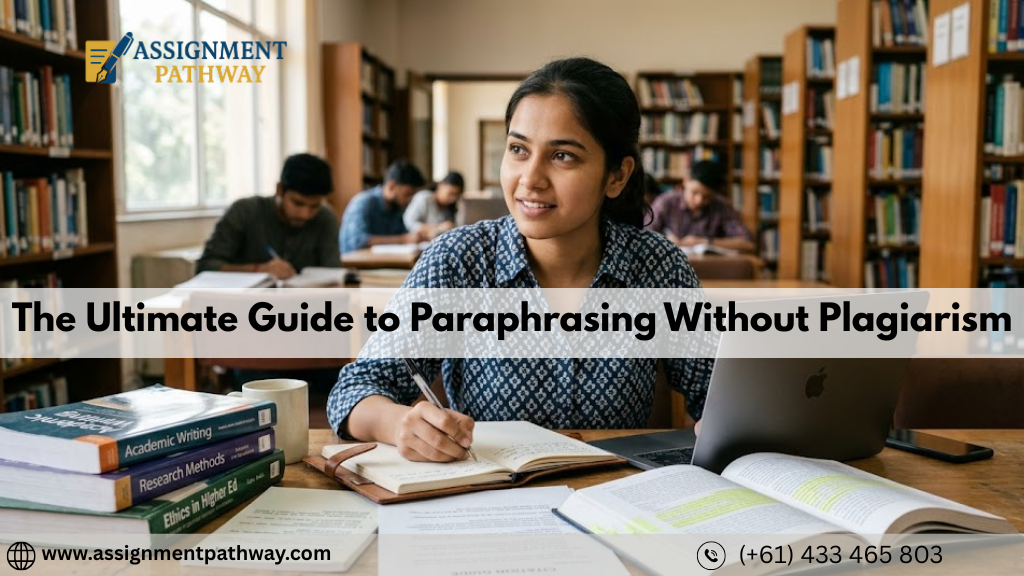
Paraphrasing is one of the most necessary academic skills: you will be able to prove that you understood, blend sources in your argumentation and avoid the harsh consequences of plagiarism. Learning paraphrasing is also essential for students pursuing their studies in Australia, as it helps them not only maintain academic integrity but also earn better grades and think critically. It is a 100 per cent human-written, practical tutorial: it will take you through the nuts and bolts of what paraphrasing is (and what it is not), step-by-step techniques, pitfalls to avoid, examples, and suggestions of where you can go next. Also, in case you are unable to figure out how to do something, you can obtain one-on-one instruction in the form of ethical and learning-based services of assignment help Australia that will not only complete your task but also assist you in cultivating your personal skills.
What is paraphrasing – and why is it important?
Paraphrasing can be defined as a way of expressing the thoughts of another individual in other words, but still conveying the original meaning. It is not similar to summarising (reducing content) or quoting (verbatim words and quotation marks). When paraphrased sufficiently, it demonstrates that you have comprehended it, and you have the chance to use evidence in your argument in a flowing way.
Why it matters:
- Academic honesty: Australian universities do not accept instances of plagiarism; the insufficiency of proper paraphrasing can be reported as misconduct.
- Being more accurate: every time you paraphrase, you must process and convey ideas in a manner that would suit your essay.
- Greater argumentation: a mash-up of paraphrases and analysis is an expression of critical source use.
- Development of skills: The skill of excellent paraphrasing will help to improve reading comprehension and command of the topic.
- Ethics regulations: paraphrasing, quoting or citing.
You should paraphrase when you want to use an argument of another author to support your argument. Limit quotations – originality of phrase, definitive definition or when the expression of the author is unquestionably essential. References should be made regardless of whether paraphrasing or quoting is done.
Practical rules:
One has to cite the paraphrased ideas, the least familiar facts, or data and statistics.
The process of paraphrasing also demands altering the words and the sentence structure as well – mere replacement of certain words with synonyms is risky.
Retain such terms with a citation in case a passage has some technical terminology or a certain definition.
Paraphrase section by section with long or complex ideas and make sure that the original meaning has been retained.
Step-by-step paraphrasing technique.
The steps to be followed to come up with safe and accurate paraphrases are the following:
Step 1 — Read and comprehend.
Read it a couple of times, and you will clear yourself of it. Identify the key point, supporting points, and any specialised words.
Step 2 – Store away the source.
Always do not look at the text when you start writing. This will minimise the possibility of imitating the original form and wording.
Step 3 — memorise and write.
Write down the idea, explaining it to a classmate using your own words. Pay attention to simplicity and clarity.
Step 4 — Revise and compare.
Compare the paraphrase and the original. Ensure that you did not use any special phrases or keep the structure of the sentence. Rephrase once more in the event of similar wording.
Step 5 — Cite and combine.
Refer to the source according to the referencing style of your university (APA, Harvard, etc.). Blend the paraphrase with your own analysis: do not put it in without comment.
Step 6 — Documentation.
Store original text, your notes and drafts. This comes in handy when you may be called upon by a tutor to explain the logic behind your thoughts, and it is ethical conduct.
Examples of bad vs good paraphrases.
Example source:
The issue of climate change has altered the rainfall pattern and has led to increased extreme weather patterns in most parts of the world, a factor that has affected food security in already vulnerable areas.
Bad paraphrase (excessively close):
The change in the distribution of rainfall and the increasing frequency of severe weather conditions are climate change in the world, both of which have an impact on the food security of vulnerable areas.
Good paraphrase:
Climatic changes cause a shift in the rainfall of the areas and the frequency of severe weather, and this threatens food supply in the already precarious areas; source reference.
Quoting when appropriate:
According to Smith (2023), the pattern of rainfall is not the same because of climate change; however, the quote is usable only when it is necessary to use this very wording.
Common pitfalls in paraphrasing and how to evade them.
Replacement with synonyms: Replacement of words one-on-one is more likely to preserve the original structure of the sentence.
Correction: rearrange sentences and merge or divide sentences.
Paraphrasing without reference: This is even a perfect paraphrasing which requires reference.
Fix: make sure to reference a reference list and an in-text citation.
Paraphrasing excessively: Paraphrasing the whole sentences of a source is not good as it will make your essay difficult.
Fix: include paraphrases with your own analysis and employ summaries where necessary.
Loss of meaning: It is quite simple to corrupt the original thought through alteration of words. Fix: re-read the source and consult a peer or tutor on whether the meaning has been retained.
Word paraphrasing: It can be deceptive to use incorrect words in place of the exact words used.
Decision: apply some technical terms and cite the source.
Support systems and procedures.
Useful supports:
- Note-taking: When conducting your research, take brief notes of your sources using your own wording.
- Reference managers: EndNote, Mendeley or Zotero are easier to use.
- University writing centres: the majority of Australian universities provide free workshops and individual consultations.
- Peer review: exchange papers with peers to find unintentional similarity.
- Professional, learning-based services: In case you need further help, effective assignment help Australia services can assist you with tutoring on how to paraphrase, revising a draft, and instructions on how to reference – choose services which are learning-oriented and prioritise originality.
What and when to expect to receive help.
In case you have a problem with paraphrasing complicated content, refer to your course tutor, university writing centre, or a good assignment help Australia agency, which provides coaching (not ghostwriting). Request tutors to model paraphrasing skills, proofreading and model citing. Always avoid services that offer to complete your assignment and hand it over to you, but go to those that will train you on how to do it ethically.
Conclusion
Plagiarism is a vice that can be avoided through learning, and it improves academic writing and critical thinking. Apply the step-by-step method: comprehend, memorise, edit and reference. Confidence is developed with the assistance of good note-taking, feedback and university resources. You can also trust the services of the ethical assignment help Australia, which will guide you through the process rather than replace your work in case you need further help. Practice will make paraphrasing a part and parcel of reading, interpreting, and writing about the world.