A resilient supply chain that is effective and resilient is a policy in the dynamic world market. Whether you are a logistics manager, operations student, or business leader, understanding the pillars of the supply chain strategy and design will help you to reduce cost, improve the quality of the services, and recover faster in case of a disruption. This tutorial informs you of what a good supply chain strategy and design will entail, what factors to keep in mind when implementing it in reality, and how a proper academic and professional support system, including the one offered by Assignment Pathway, will transform you into a master of these concepts.
1. The Supply Chain Strategy is aligned with the Business Objectives of an organization.
Any supply chain strategy is grounded in alignment with the overall business objectives. This also requires a supply chain to consider the value proposition of the company, which may be a low-cost, high-service, fast innovation, or sustainability. Key steps include:
- Developing the requirements of the client (cost, speed, variety, customization).
- Experiencing how distribution, sourcing, and inventory decisions can be implemented in the supply chain to meet those requirements.
- Formulation of measurable KPIs (fill rate, lead time, inventory turnover, and cost-to-serve).
- Network Design: Facilities, Flows, and Locations.
2. The distribution of the factories, warehouses, and distribution centers, and also the flow of products between them, will depend on network design. Important considerations.
- Examples of facilitation are production, cross-dock, value-added services, and regional fulfillment.
- There is a trade-off between decentralization and centralization (cost versus responsiveness).
- Routing and transportation to reduce costs and lead time.
- When creating a resilient network, sensitivity analysis and scenario planning would be necessary.
- Demand forecasting and S/OP (sales and operations planning.
3. The demand and customer needs match-making is dependent on effective demand forecasting. Nowadays, statistical methods are confused with market intelligence.
- Use time-series models, causal models, and machine learning where they are required.
- Make sales, marketing, and financial forecasts through S&OP or IBP (Integrated Business Planning).
- Change the forecast into the capacity, inventory, and procurement measures to avoid excess inventory or stockout.
- Optimization and Strategy Inventory.
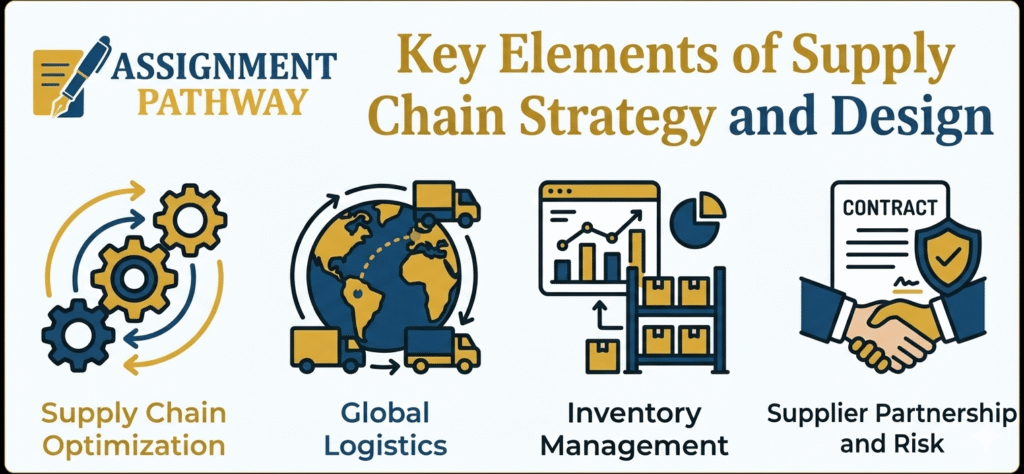
4. The variability can be absorbed by the service via inventory, which is the buffer. The strong inventory strategy solves.
- Stocking: finished goods, working inventory, safety stock, and decoupling inventory.
- Location: good location in network nodes.
- Percentages to keep: service level, EOQ, and inventory optimization software.
- The adoption of inventory segmentation (ABC / XYZ) can help in prioritizing policy of investment and control.
- Sourcing and supplier relationship management.
5. Sourcing strategy affects cost, quality, and risk exposure. Core elements include.
- Supply selection and qualification criteria (cost, capability, reliability, ESG).
- Contract format: Prices, lead time, penalties, and collective forecasting.
- Supplier performance management and development programs to advance a continuous improvement program.
- This is necessary in the trade-off that is between single sourcing, which is efficient, and multi-sourcing, which minimizes risks.
6. Transportation Management and Logistics.
Transportation and last-mile delivery are large cost drivers and determinants of customer experience.
Key focus areas:
- Balance of mode (air, sea, rail, road), speed.
- Backhaul prospects, route planning, and consolidation.
- Visibility and tracking (real-time TMS integrations) to improve on-time delivery and exception handling.
- It is also becoming more and more important that sustainable logistics activities (fuel efficiency, modal shift) gain significance.
- Process Design and Operational Excellence.
7. This is because good supply chains rely on processes that are efficient and repeatable.
- Optimize processes using the lean philosophy to get rid of waste and reduce variability.
- Implement Six Sigma and Kaizen as quality control and continuous improvement.
- The inter-functional work and process ownership accelerate the problem solution.
- Digital Enablement and Technology.
8. Digital tools enable visibility, decision support, and automation.
- Execution and planning are ERP, WMS, TMS, and advanced planning systems (APS).
- Predictive forecasting, demand sensing, and optimization AI, machine learning.
- IoT and blockchain to enhance the tracking and status of trackers.
- Investment in an integrated architecture that is capable of being scaled reduces data silos and speeds decision-making.
- Resilience Planning/ Risk Management.
9. Natural catastrophes and geopolitical transformations are only a few instances of the interruptions in the supply chain that require advance risk planning.
- Establish essential dependencies and areas of vulnerability.
- Set up contingency plans: second-source, safety stock, dual-source.
- Run simulated scenario-based stress tests of the network, and maintain the crisis communications.
- Sustainability and Compliance.
10. It is no longer optional.
- Environmental and social responsibility.
- Include sustainability objectives in the design process: redesign packaging, routing, carbon efficiency, and reverse logistics.
- Ensure that markets (customs, trade, labor standards) are regulated compliantly.
- Be transparent on sustainability measures and growth.
- Talent, Organization, and Governance.
11. A well-managed supply chain needs to possess the right individuals and management.
- Institute accountability in the strategy, planning, procurement, operations, and logistics.
- Invest in education — digital, analytics, cross-functional problem solving.
- These are governance mechanisms that allow congruent incentives and assist in making data-driven decisions.
- Measures that can be implemented to have a strong supply chain strategy.
- Start with a session on strategy review: concentrate the stakeholders on missions and constraints.
- Place more emphasis on data utilization: implement swift-win programs to improve quantifiable KPIs.
- Piloting of changes under a controlled environment.
- Invest in change management: communication, training and slow implementation of the technology.
- Evaluate and enhance the process through dashboards and quarterly S&OP cycles.
The Advantages of Supporting Academic and Professional.
Relevant material and real-life examples are faster to comprehend for a person who reads such notions, regardless of their status or profession. Assignment Pathway offers academic services in supply chain, logistics, operations management, et cetera. You should have a person to help you write a paper, case study, or learn a complicated model. You may get a professional voice on the issue so that your assignment is made according to the academic standards and industry practice.
Conclusion
A supply chain strategy should be designed in a way that the network design, sourcing, inventory, technology, and people are considered carefully in alignment with your overall business goals. The focus on resilience, sustainability, and digital enablement has been a necessity in the present context. Students and practitioners who want to get to a more extreme level of support may refer to resources and professional help of such trusted providers as Assignment Pathway to make complicated issues more accessible and practical.