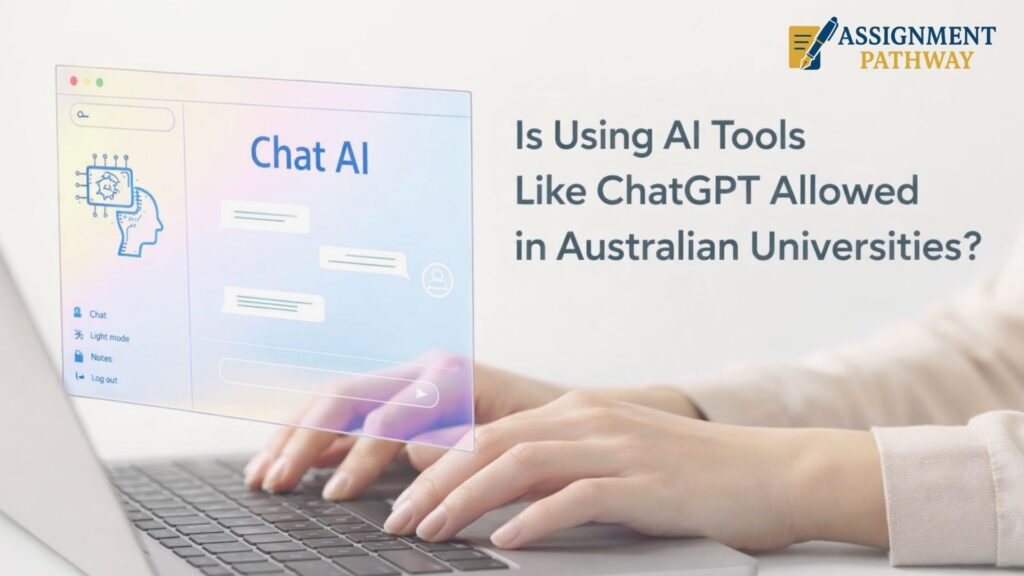
The Question Most Students Are Afraid to Ask But Everyone Is Googling
You’re staring at a blank Word document. The assignment brief sounds simple, yet nothing you write feels academic enough. English isn’t your first language. You’re worried about referencing. You’re worried about time. And somewhere between stress and exhaustion, you open ChatGPT then immediately panic.
Is this allowed?
Will I get caught?
Is using an AI assignment writer considered cheating in Australian universities?
For international students especially, this fear isn’t hypothetical. One wrong decision can affect grades, academic records, or even visa status. Unfortunately, most blogs online give vague answers like it depends on the university and leave you more confused than before.
So let’s talk honestly without scare tactics or loopholes about how AI tools actually fit into Australian academic rules today.
The Real Truth: AI Tools Are Not Completely Banned But Not Fully Free Either
Australian universities have not banned AI tools completely, what they have banned is misuse. Most universities now treat tools like ChatGPT the same way they treat calculators, Grammarly, or Google Scholar. The tool itself isn’t the problem. How you use it is.
In simple terms:
- Using AI to replace your thinking is equals to academic misconduct
- Using AI to support your learning is often allowed
That grey area is where most students get confused and where most mistakes happen.
Why Do Australian Universities Care So Much About AI Usage?
Australian education focuses heavily on critical thinking, independent analysis and original argument development. When a student submits work generated entirely by an AI assignment writer, it removes the very skill the assignment is designed to test.
Universities aren’t worried about technology. They’re worried about:
- Students graduating without core skills
- Degrees losing credibility globally
- Unfair academic advantage
This is why policies focus on authorship, not the tool itself.
When Using an AI Assignment Writer Is Usually Acceptable?
Based on current university guidelines and academic integrity framework, AI tools are generally acceptable when used for support, not substitutions.
Commonly allowed uses includes:
- Understanding complex assignment questions
- Brainstorming topic ideas
- Improving the grammar and sentence clarity.
- Summarising long readings for comprehension
What matters is that you still write the assignment yourself and understand every sentence you submit.
Where Students Cross the Line Often Without Realising It?
Many students don’t intend to cheat but still end up violating rules.
Here’s where problems usually start:
Submitting AI-Generated Content as Your Own
Copy-pasting paragraphs directly from an AI assignment writer even after light editing is risky. Universities consider this unauthorised assistance, similar to paying someone else to write your work.
Using AI Without Disclosure When Required
Some universities now explicitly ask students to declare AI usage. Ignoring this can be treated as dishonesty, even if the AI use was minor.
Relying on AI for Referencing
AI tools often:
1. Invent references
2. Mix citation styles
3. Misinterpret sources
Submitting incorrect references is a fast way to lose marks—or worse, trigger plagiarism reviews.
“But Everyone Uses It” — Why That Argument Fails in Australia?
This is one of the most common and dangerous assumptions. Australian universities don’t operate on peer behaviour. They operate on documented policy. Saying “everyone uses AI” won’t protect you during an academic misconduct investigation.
Markers don’t need perfect AI detection tools. They look for:
- Sudden changes in writing style
- Over-polished language inconsistent with previous submissions
- Arguments that lack personal engagement or context
Ironically, overusing an AI assignment writer often makes work more noticeable, not less.
How Universities Detect Problematic AI Use Without Saying It Publicly?
Universities rarely rely on AI-detection software alone. Instead, they use pattern recognition:
- Oral follow-up questions you can’t answer
- Requests to explain your argument in person
- Comparison with past assignments
- Logical gaps that suggest surface-level understanding
Detection isn’t always technical. It’s academic.
A Practical Framework: How to Use AI Safely as a Student
If you’re going to use AI tools and most students will, follow this SAFE framework:
S – Start with your own ideas
Write rough thoughts before opening any AI tool.
A – Ask for guidance, not answers
Use prompts like “help me improve clarity” instead of “write my essay.”
F – Fact-check everything
Especially statistics, laws, and references.
E – Edit in your own voice
If it doesn’t sound like you, it’s not safe to submit.
This approach keeps you on the right side of academic integrity while still reducing stress.
Common Mistakes International Students Make And Why Do They Hurt?
Mistake 1: Treating AI like a private tutor
AI doesn’t know your university’s marking rubric. Over-trusting it leads to off-topic or low-scoring answers.
Mistake 2: Using AI to “fix” weak understanding
If you don’t understand the topic, AI-written content won’t save you during viva questions or resubmissions.
Mistake 3: Assuming language support = content creation
Universities allow language assistance—but not idea replacement. Mixing the two is risky.
What Universities Actually Want You to Do?
Here’s the part most blogs don’t say:
Australian universities know students are using AI. What they want is:
- Transparency
- Skill development
- Responsible use
Some courses now actively teach how to use AI ethically. Others allow AI for drafts but not final submissions. The safest move is always to check your course guide, not random internet advice.
Final Takeaway: AI Is a Tool Not a Shortcut
Using an AI assignment writer won’t automatically get you in trouble in Australian universities. But using it the wrong way absolutely can.
The students who struggle most aren’t the ones who use AI. They’re the ones who:
- Use it secretly
- Use it blindly
- Use it instead of learning
If you treat AI as a study companion not a ghostwriter you protect your grades, your integrity, and your future.
And that confidence? It’s worth far more than a last-minute shortcut.