One of the quickest ways to earn marks and reduce rework is to meet expectations on university rubrics. To most Australian students, having part-time jobs, placements and studies, the effective use and knowledge of rubrics makes a loose roadmap look like a roadmap. This guide has been written by an Australian learner with an Australian-based approach to assignment help, and thus the instructions are offered to you in a simple, human manner to present your assignments in a rubric-friendly, original, and assessment-friendly manner.
What is a rubric (and why should it matter)?
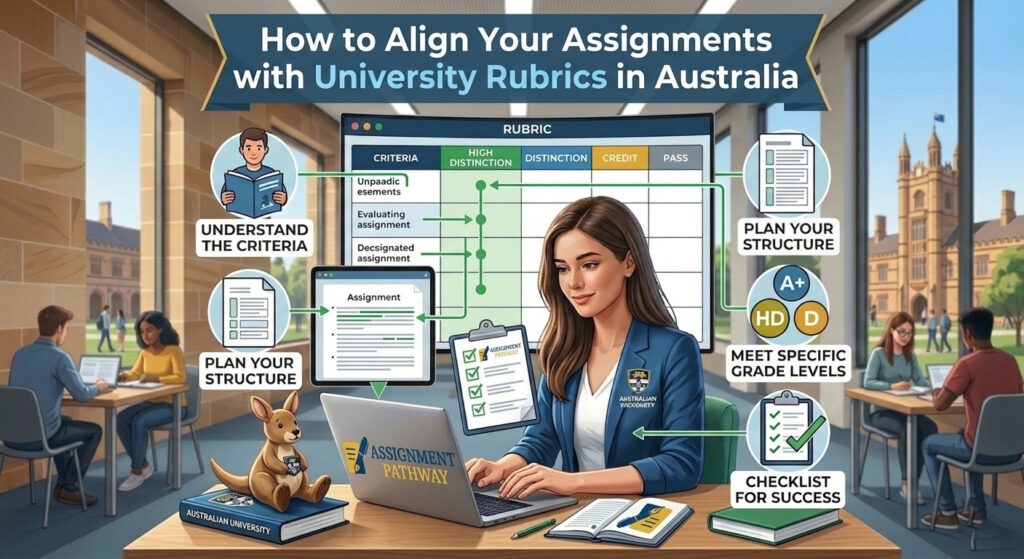
A rubric is a scoring guide that lists criteria that will be used by your assessor and provides specifications of the performance requirements of a given criterion. Some of the common types of rubrics include understanding of content, critical analysis, structure, referencing, and presentation. The rubric in the form of a checklist serves as a focus, that is, are you working on what the examiners are looking at, not what you think they have to look at.
Step 1- Before you begin, read the rubric.
Read the rubric and write or research one sentence. Highlight:
- Strategic evaluation, evidence application, etc., are important evaluation standards.
- Percentage or weight of each criterion.
- Guidelines on word count, formatting and referencing style.
- The reason is that knowing all these aspects in advance will not only save you time and energy but also help you prioritise your time, and this is what most assignment help Australia gurus suggest.
Step 2- Turn rubric language into tasks.
The words used in the rubrics can be academic and abstract. Divide it into action:
- Demonstrates critical analysis: Compare at least three viewpoints, find assumptions, and assess evidence.
- Coherence and structure -Write an introduction that has a thesis, clearly defined sections, and a conclusion summarising findings.
- “Used sources are either appropriate and in proper format (at least X sources)” → Use either APA or Harvard format, use all of them, and give a reference list.
- It is an essential thing that is learned within on-campus writing centres and also one of the first things that is often recommended by assignment help Australia tutors.
Step 3 — Formulate an evidence plan.
Numerous rubrics are based on the amount and quality of evidence. Planning the evidence:
- Determine the sources (peer-reviewed articles, government reports, textbooks) and their number.
- Identify the source that will support every primary point or paragraph.
- Direct quote and page numbers to be used in future.
- A plan of evidence saves you time and makes your arguments better- an evidence plan saves you time and is more comprehensive than the rubric.
Step 4 — Plan using headings in a rubric.
Write an elaborate plan that charts areas to rubric standards:
- Introduction (addresses learning outcomes and thesis) – connected to the criterion of understanding.
- Literature review / Background – supports the use of evidence and situational knowledge.
- Analysis / Discussion (subheadings to each criterion point) — deals with the point of targets, which are critical analysis and original insight.
- Conclusion (handles implications and limitations) – relates to synthesis and academic judgement.
- Such a way of briefing will ensure that every section will have its purpose that will be directly related to what will be evaluated.
Step 5 -Write the rubric before you.
When drafting, keep the rubric on a second screen, either on paper or on a checklist, next to you. You should cross the points of the rubric you have achieved when you are done with a section. The habit recommended by the assignment help Australia coaches eliminates omissions and makes the revision process more focused and quicker.
Step 6 – Utilise signposting and connecting language.
Markers pursue consistency of argument. Signposting (e.g., This section argues., In contrast., Therefore. etc.) and clear paragraph topic sentences are useful to allow examiners to find the necessary evidence. Connect paragraphs in a manner that the ideas are connected logically- this addresses the item of structure and coherence rubric directly.
Step 7 — Check referencing and academic voice.
In rubrics, there are usually referencing and academic style requirements. Before submission:
- Make sure in-text citations and reference lists are done in the necessary format (APA, Harvard, etc.).
- Write in scholarly yet easy-to-understand language- stay out of jargon and unsubstantiated assertions.
- Restrict direct quotes; paraphrase to demonstrate understanding.
- A lot of students avail of assignment help Australia services through end proofreading, which is preoccupied with referencing and tone.
Step 8 – Self-reflection with the help of the rubric (and consult a second opinion).
Use the rubric to self-grade your draft. Tell the truth–high distinction, distinction, credit, pass? Discover areas of weakness and correct them. Where possible, request peer feedback, tutor feedback or favorite writing service feedback. When obtaining external help, find services that do not replace your work, but rather emphasise learning (feedback and edits) – it is the morally and practically correct thing to do.
Step 9 — Polish presentation and submission requirements.
The criteria of presentation are presented with rubrics. Check:
- Word count (within 10% limit or not)
- Formatting: font, margins, headings, and page numbers
- Attachments: appendices and tables, figures and ethics approvals (where necessary).
- A polished submission demonstrates a feeling of professionalism and attention to detail- small details that can lead to a difference in the marginal grades.
Step 10 – Study according to the feedback on the following task.
Once marked, go through your feedback. Return to the rubric to determine where you have done well and where you ought to improve. Keep a list of the most frequent issues that you make (e.g., bad conclusions, inconsistent referencing) in future work that you address in advance. This is a reflective practice, which is a long-term plan adopted in assignment help Australia advice.
Ethical use of foreign aid.
Extrinsic help, whether it be tutoring, proofreading, or structured feedback, can be of unbelievable help to a responsible extent. Ethical use means:
- Editing, clarifying structure, teaching: Asking somebody to assist you in improving your work.
- One should not present original work as the work of another individual.
- Looking at university policies concerning collaboration and so-called support.
Choose providers of annotated feedback and learning resources and unfinished assignments. Academic honesty has to do with morality and education provision, and it will help you to acquire competencies.
Quick rubric-match checklist (summary).
- Get acquainted with the rubric and brief.
- Divide phrases in rubrics into tasks.
- Place map evidence on each rubric.
- Write an outline, including headings and rubrics attached.
- Write the paper with the rubric open and check.
- Apply signposting, academic voice, and correct referencing.
- Self-assess, get feedback and improve on presentation.
- Consider feedback to constantly improve.
Conclusion
Modifying your assignments to match the university rubrics is practical and reduces the time spent on futile assignments, and increases the marks. Australian students with numerous obligations consider a rubric-based workflow (planning to revision) as a time-saving approach that helps them become more organized. See assignment help Australia solutions, which focus on learning, provide clear feedback and respect academic integrity when external assistance is required. As you get used to it, you will discover that rubrics are no longer a challenge but a useful guide towards academic achievement.