Assignment Pathway > Blog > Uncategorized > Role of the Literature Review in Thesis and Dissertation Writing
Role of the Literature Review in Thesis and Dissertation Writing
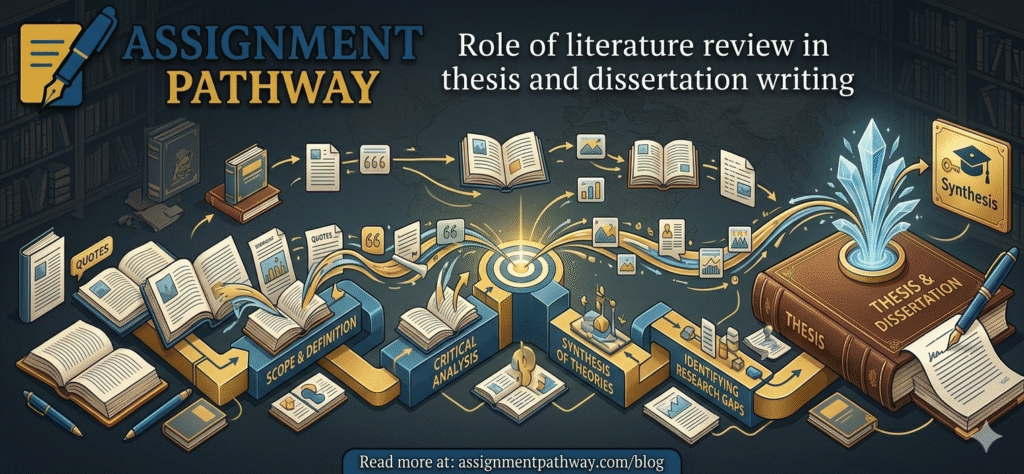
A literature review is not merely a summary of the known literature; it is the basis on which a capable thesis or dissertation is made. In the case of students who are studying in Australia, the literature review is important to ensure that they come up with research that will be credible, original, and scholarly. This blog gives an understanding of the importance of the literature review, the parts of the literature review, the pitfalls that should be avoided, and tips that can be practically applied to enable you to come up with a literature review that supports your thesis or dissertation. In case you require additional assistance, you may refer to Assignment Help Australia and get help based on the local academic standards.
The reason why the Literature Review is important.
The literature review preconditions your research. It does the following:
- Creates context and background of your research topic.
- Demonstrates knowledge of the main theories, debates, and approaches.
- Finds gaps, inconsistencies, or gaps in the available literature.
- Elaborates on why your study is necessary and explains how your research will add new knowledge.
- Helps you formulate research questions and choose appropriate methodologies.
A properly built literature review demonstrates to examiners that you are able not merely to describe sources of information, but also to critically interact with them. In the case of Australian universities, where critical thinking and originality are highly valued, this critical involvement is an indicator of high-quality research. When many students feel the need to create a literature review and are overwhelmed by the seemingly daunting task, Best Assignment Help Australia can assist in providing structured tips and model frameworks that suit the local standards.
The Major Elements of a Successful Literature Review.
(1.) Clear scope and focus
Start with the scoping: What subjects, deadlines, regions, or academic disciplines will you cover, and why? Keeping the scope is against having to get distracted and makes the text coherent.
(2.) Thematic/conceptual organisation
Instead of summarising sources individually, conduct group studies based on themes or concepts, or research methodology. It is a system that enables you to identify patterns in the literature and compare and contrast findings.
(3.) Critical appraisal
Assess the strengths and weaknesses of every study. Among the things to think about are: How effective are the techniques? Do the data support the conclusions? What are some of the prejudices or suppositions? Critical appraisal shows that you are capable of quality and relevancy assessment.
(4.) Connect and relate to your study
Synthesis refers to the process of pulling together separate studies into a large story. Show how your research questions are informed by the body of literature as a whole, and make it evident how any gaps or disagreements relate to the goals of your thesis or dissertation.
(5.) Methodological review
In case your project is empirical, then you can have a methodological section that will critique the general techniques that are employed in the discipline, and why you decided to employ this method. Arguments in favor of the method and its weaknesses/strengths make your methodology more justified.
(6.) Theoretical framework
Describe the theoretical frames of your work. Your analysis of the data is guided by a clear theoretical framework, which also places your work in the context of previous research.
The Impact of Literature Review in a Thesis or Dissertation.
(1.) Developing research questions: A survey of what has already been done helps you in identifying questions that will not be answered or disputed statements. The understanding is used to formulate more incisive and original research questions.
(2.) Designing techniques: Knowledge of past methodologies assists you in adopting, adapting, or innovating an appropriate research design. You are able to circumvent traps that others have fallen into and develop excellence.
(3.) Establishing a position of your argument: The literature review allows you to make a claim of where your work is situated in the field, be it an empirical gap, a challenge to a theory, or a continuation of a methodology.
(4.) In supporting analysis and discussion: You will use the literature to compare, contrast, and situate results across the literature in interpreting the results. A good literature review offers the materials for a convincing discussion chapter.
Common Pitfalls to Avoid.
(1.) Descriptive summaries: It is simply a summary of studies without any critical analysis that will render the review useless. Make an effort to integrate and compare, highlighting the similarities and differences between sources.
(2.) Bad organisation: It is difficult to follow your argument because it consists of several paragraphs that do not have any connections. Outline with clear transitions and subheadings.
(3.) Poor breadth or depth: To narrow a focus is to miss significant arguments; to broaden it is to treat superficially. Measure both the breadth and depth of project objectives.
(4.) Omission of recent studies: Your failure to incorporate the recent studies can render your review appear as being outdated. Put a high premium on modern learning, particularly in dynamic subjects.
(5.) Weak connection to your study: When the review has no outright connection to your research questions and research methods, its relevance will be less. Always refer to your project.
Step-by-Step Guide to Composing a Good Literature Review.
(1.) Start early and read widely.
Long before you start writing, read widely. You can discover significant writers, classic works, and compelling arguments by reading early.
(2.) Take a reference management tool.
Citation software such as EndNote, Mendeley, or Zotero is time-saving due to organising citations and generating bibliographies in the appropriate Australian formatting style.
(3.) Take analytical notes.
It is not enough to write down bibliographic information, but to type down the argument, methods, major conclusions, and strong and weak aspects of every source. These are notes that are used to build on synthesis.
(4.) Map the literature.
Make concept maps/matrices to visualise the relationships in the study – in terms of theme, method, population, or findings. Mapping makes synthesis easier.
(5.) Write thematically and not chronologically.
Write drafts based on themes or arguments. Chronology can be used to deal with historical developments, and critical synthesis would be more suitable when dealing with thematic organisation.
(6.) Seek feedback and revise
Distribute drafts to peers, supervisors, or academic support services. Feedback helps in seeking out the gaps, arguing out, and organizing better.
(7.) Be academically upright.
Citations must be done appropriately, and plagiarism must be shunned. On the one hand, there are university guidelines, and on the other hand, a professional visit, in case of doubt. The process of reference and quality checks can be outsourced with the assistance of such services as Assignment Help Australia.
How Assignment Help Australia can be of assistance to you.
The literature review process of several Australian students can be accelerated by professional support. The services provided by the academic assistance can be applied to help with:
- Finding relevant literature and foundational works.
- Arrangement of the review and the development of thematic parts.
- Programmatically assessing research and synthesizing the findings.
- Referring to the sources in the format of an Australian university.
- The presence of annotated bibliographies or sample essay paragraphs to refer to.
Interestingly, good providers like teaching and academic support are not interested in writing something to present as your paper. Ethical assistance may bolster your research abilities, besides being in a position to conform to university policies through ethical utilization of assistance, such as to boost organization, readability, and scholarly traditions.
Final Thoughts
One of the primary bases of any thesis or dissertation is a literature review. It gives your research question, forms the decisions of your methodology, or your analysis. The requirement for Australian students to come up with a strict literary review is an indication of academic maturity and critical ability of the highest value to the examiners.
In case the literature review process is a challenging task, do not forget that there is definite ethical assistance. Using university resources, peer-to-peer networks, or professional assignments like Assignment help Australia, you can develop a literature review, which renders your thesis/ dissertation more original, detailed, and credible. Take a methodical and focused look, and focus on vital analysis, and ensure that all in the review can be applied to your studies; that is the formula to a solid and justifiable research project.
[/vc_column_text][/vc_column][/vc_row]
Get A Free Quote!
Related articles