If you’re a university student, chances are you’ve asked yourself some version of this question at least once: How exactly am I supposed to do footnotes?
You may understand why citations matter, but the “how to do footnotes” part often feels unnecessarily confusing. Different formats, tiny numbers, placement rules, and vague instructions from professors can turn a simple research task into a formatting headache. This guide is written for students who want clarity, not theory. We’ll focus on how footnotes actually work in real assignments, what examiners look for, and the small mistakes that quietly cost grades.
What Footnotes Are Really Doing in Your Assignment?
Let’s skip the textbook definition. Footnotes are not there to make your paper look smarter. They exist to answer one silent question your reader always has: “Where did this information come from?”
A footnote says:
- This idea isn’t mine, I know whose it is
- I didn’t make this up
- You can check this source if you want
They also let you keep your writing clean. Instead of interrupting your paragraph with explanations or citations, you push that extra information to the bottom of the page where it belongs.
When Footnotes Actually Matter and When They Don’t?
One of the biggest mistakes students make is either footnoting everything or footnoting almost nothing.
Here’s the practical rule. You need a footnote when:
- You quote directly from a book, article, or document
- You paraphrase a specific argument, idea, or finding
- You reference laws, policies, court cases, or historical records
- You use statistics, studies, or data you didn’t generate yourself
- You add background information that isn’t part of your main argument
You don’t need a footnote when:
- You’re stating common knowledge
- You’re explaining your own interpretation
- You’re building on a point you already cited in the same paragraph
How to Do Footnotes Step by Step?
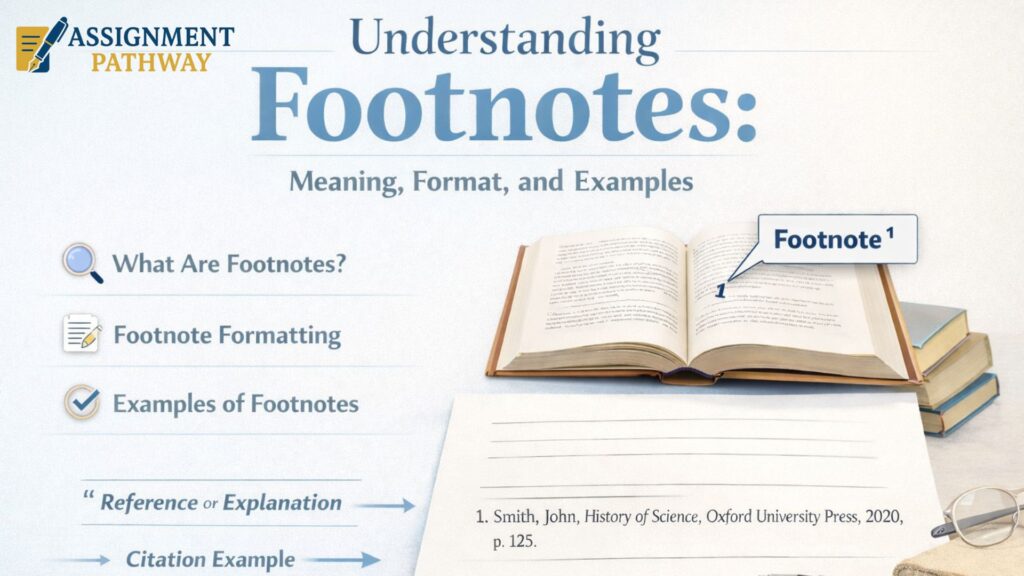
Step 1: Place the number in your text
When you reach the sentence that needs a citation, insert a small superscript number right after it.
- The number goes after punctuation, not before
- It should match the footnote at the bottom of the page
Example: Poor sampling methods often distort research conclusions.¹
Step 2: Write the matching note at the bottom of the page
That number appears again at the bottom of the page, followed by the source details.
The key thing: the footnote explains or credits the sentence it’s attached to. Nothing more, nothing less.
Step 3: Give full source details the first time
Your first footnote for a source should include:
- Author’s name
- Title of the work
- Publication details
- Page number
Later references to the same source can be shortened.
What a “Correct” Footnote Looks Like, In Real Assignments?
Exact formatting depends on your required style, but most footnotes follow the same logic.
Book example- John Smith, Research Methods in Psychology (Oxford: Oxford University Press, 2021), 45.
Journal article example- Ayesha Khan, “Sampling Bias in Behavioral Studies,” Journal of Social Research 14, no. 2 (2020): 88.
Website example- World Health Organization, “Mental Health Statistics,” last modified June 2023, URL.
Here’s something students rarely hear: Your lecturer cares more about consistency than perfection. Pick the right style and stick to it throughout.
Mistakes That Quietly Cost Students Marks
These don’t always trigger plagiarism software, but markers spot them instantly.
Footnotes that don’t support the sentence- If your footnote source doesn’t clearly back up what you’re saying, it weakens your credibility.
Mixing formats- Switching styles halfway through your paper signals rushed work.
Too many footnotes- If every sentence has one, it looks like you don’t trust your own writing.
Missing page numbers- Especially serious when citing books or journal articles.
Using footnotes instead of a reference list- Unless your lecturer explicitly allows this, you usually need both.
A Quick Footnote Check Before You Submit- Before handing in your work, ask yourself:
- Does every quote have a footnote?
- Are paraphrased ideas credited?
- Is formatting consistent?
- Are page numbers included where needed?
- Do footnotes align with the reference list?
A Final Word
Learning how to do footnotes isn’t about obsessing over commas or italics. It’s about showing academic honesty. Footnotes tell your reader that you know where your ideas come from—and you’re confident enough to show it. If you’re ever unsure, clarity beats perfection. A slightly imperfect footnote is far better than no footnote at all. With practice, footnoting stops feeling technical and starts feeling automatic. And once that happens, you can focus on what actually matters: making a strong argument.