If you are a university student right now, chances are you have heard at least one unsettling claim about the Turnitin AI detector. That it can “see through everything.” That it flags normal academic writing as AI. That one wrong submission could put your degree at risk. This article is written for students who are genuinely trying to do the right thing but feel anxious, confused, or unsure where the real boundaries are. Rather than repeating surface-level explanations, we will look at how Turnitin’s AI detection actually works in 2026, where it performs well, where it struggles, and why so many myths continue to circulate on campus.
What Turnitin’s AI Detection Is Actually Looking At?
Turnitin is not watching how you wrote your assignment. It does not see your drafts, your prompts, or whether you struggled with wording at 2 a.m. It only sees the final submission.
The Turnitin AI detector looks for statistical patterns in language. Things like:
- How predictable the sentence structures are
- Whether word choices follow common AI-generated probabilities
- How uniform the tone is from start to finish
- How often ideas are expressed in generic academic phrasing
It does not understand your intention. It does not know whether you learned something or whether the work reflects your effort. It is pattern recognition, not judgement. That distinction matters more than most students realise.
Why AI Scores Are Often So Misunderstood?
One of the biggest sources of anxiety is the AI percentage itself. Students treat it like a plagiarism score. It is not.
An AI score is not saying, “You used AI.”
It is saying, “Parts of this text resemble language patterns commonly produced by AI.” Those are very different claims.
Usually AI flags on:
- Assignments written entirely by humans
- Work from international students using careful, structured English
- Essays that were over-edited to sound “perfect”
- Writing that followed rigid templates or model answers
Australian universities are aware of this. That is why AI scores are rarely meant to stand alone. A number without context is not evidence.
Has Turnitin Improved by 2026? Yes. Is It Reliable? Not Always.
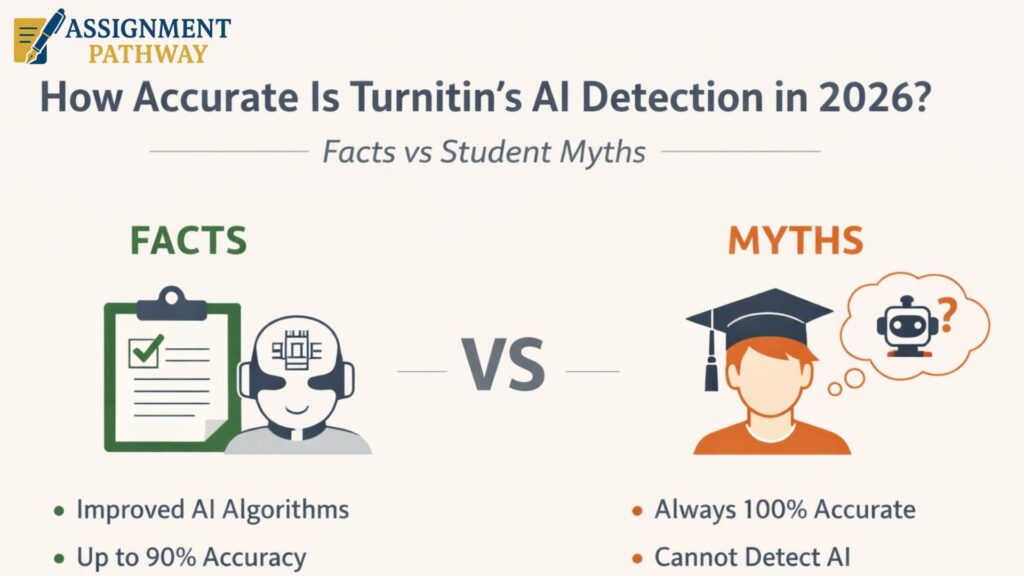
Turnitin’s AI detection is better than it was a few years ago. It is more accurate at identifying fully AI-generated essays, especially when they are submitted with minimal editing. But it is still inconsistent.
Accuracy depends heavily on:
- The length of the assignment
- The subject area
- How formulaic the writing is
- Whether the text has been heavily rewritten
Short reflective tasks are notoriously unreliable. Highly structured disciplines can trigger false positives. And polished but generic writing is still risky. The key point students miss is this: there is no universal accuracy level. Anyone claiming otherwise is oversimplifying a very messy reality.
The Myths That Cause the Most Stress
“Turnitin knows if I used AI at any point”
It does not. Brainstorming, outlining, asking questions, or checking clarity leaves no direct trace. Only the final language patterns matter.
“Anything over 20% means misconduct”
There is no fixed threshold used consistently across Australian universities. Many institutions deliberately avoid setting one because it causes exactly the panic students experience now.
“Humanising tools make AI use safe”
In real cases, these tools often make things worse. They introduce awkward phrasing, uneven tone, and conceptual mistakes that attract human scrutiny even if the AI score drops.
How Students Actually End Up in Trouble?
Most misconduct cases do not start with an AI score. They start with doubt.
That doubt usually comes from:
- Students struggling to explain their own arguments
- References that do not support the claims made
- Writing quality that suddenly changes compared to past work
- Content that sounds confident but misses core concepts
When markers notice these gaps, the AI score becomes supporting information, not the main issue. The uncomfortable truth is this: understanding matters more than wording.
A Safer, More Realistic Way to Use AI
If you use AI tools, the problem is rarely the tool itself. It is how students use it.
Here is what tends to work better in practice:
Use AI before you write, not instead of writing.
Ask it to explain ideas, compare theories, or help you understand readings.
Write the assignment yourself.
Your voice does not need to be perfect. It needs to be consistent and accurate.
Edit for clarity, not polish.
Over-smoothing language removes the human variation that real writing naturally has.
Keep your drafts and notes.
They are more useful than any detection workaround if questions arise.
The Unclear Middle Ground No One Explains Well
Many policies are vague on purpose, and that frustrates students.
For example:
- Grammar correction tools are often acceptable, but heavy rewriting may not be.
- Structural guidance might be allowed in one faculty and discouraged in another.
- Paraphrasing with AI sits in a particularly risky grey zone.
If advice from friends or social media conflicts with your course outline, trust the outline. That is what misconduct panels rely on.
If Your Assignment Gets Flagged, Here’s What Helps
First, take a breath. A flag is not a finding. What usually matters most is whether you can:
- Explain your argument clearly
- Discuss your sources confidently
- Show how you developed your ideas
- Demonstrate subject understanding
Students who can do this rarely face serious outcomes, even when AI indicators exist.
What Actually Reduces Risk
Trying to “beat” the Turnitin AI detector is exhausting and unreliable. Students who focus on understanding the material, writing in their own words, and keeping evidence of their process tend to be fine. You do not need perfect writing. You need honest engagement. Once you understand that, most of the fear around AI detection starts to lose its grip.